
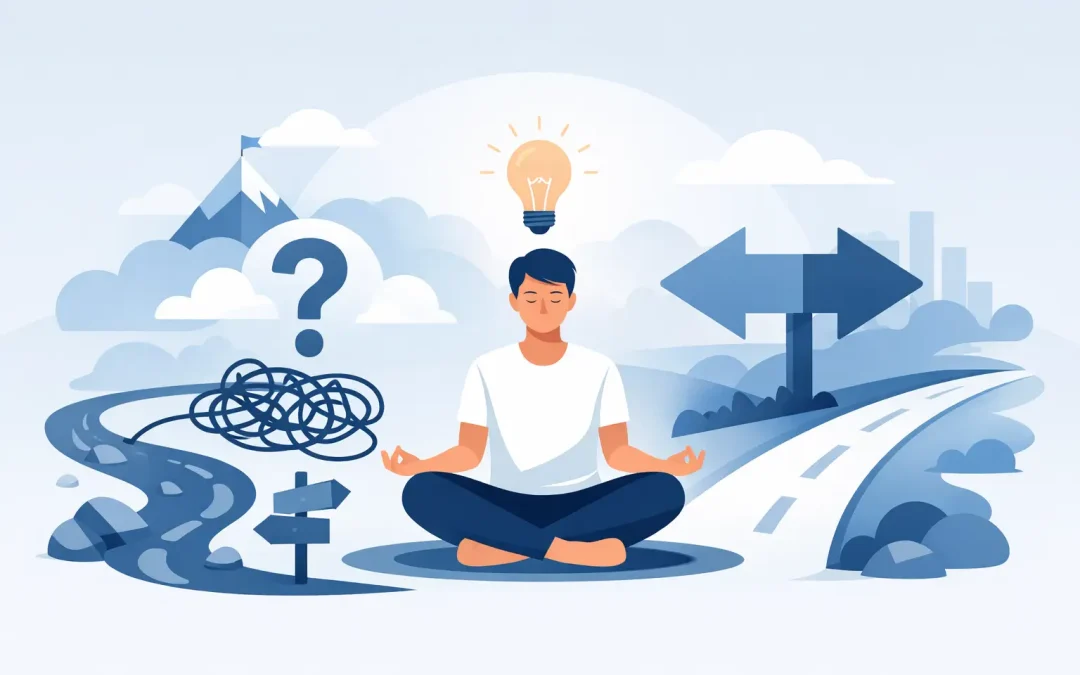
The decision is sitting in the background of everything: whether to raise your rates, leave the role that drains you, speak up in a relationship, invest in support, move countries, or finally be visible with the work you know you are here to do. You have made the lists, asked trusted friends, and searched for the “right” answer. Yet your body still feels tight, your mind keeps circling, and every option seems to carry a risk.
Meditation for decision making is not about floating above the practical realities of your life. It is a way of coming back into relationship with yourself, so fear, old conditioning, and other people’s expectations are no longer the loudest voices in the room.
For high-achieving women, indecision is rarely a lack of intelligence. Often, it is the result of having learned to stay alert, perform, anticipate needs, and make choices that preserve belonging. Your logical mind may know what needs to happen, while another part of you still believes that choosing your own path is dangerous. Meditation creates a pause long enough to hear both parts with compassion and choose from a more grounded place.
Why clarity cannot always be forced
There is a kind of decision fatigue that comes from trying to think your way out of every feeling. You replay conversations, research every possible outcome, and wait for certainty that never arrives. The more pressure you place on yourself to get it perfect, the harder it becomes to recognize what is true.
Your nervous system has a great deal to say about this. When you are in stress, your body is organized around protection. A bold business decision can feel like a threat. Rest can feel irresponsible. Visibility can stir up an old memory of being criticized, dismissed, or told you were too much. In that state, a decision may be driven by urgency, pleasing, avoidance, or the need to prove yourself rather than by your deeper values.
Meditation does not promise that every choice will become easy. Some decisions hold real grief, financial consequences, or necessary uncertainty. What it can do is help you separate the discomfort of growth from the inner signal that something is not aligned. That distinction is where self-trust begins.
What meditation for decision making actually offers
A steady meditation practice teaches you to notice thoughts without immediately obeying them. This is especially powerful when your inner dialogue sounds convincing but familiar: “I need more credentials first.” “I cannot disappoint them.” “What if I fail publicly?” “I should wait until I feel ready.”
When you sit with the breath, sensations, and emotions beneath these thoughts, you may discover that the story is not the whole truth. Perhaps the hesitation is wisdom asking you to slow down and gather information. Or perhaps it is an old protective pattern trying to keep you small because expansion once felt unsafe.
The goal is not to silence your mind or force a spiritual answer. The goal is to become more present to the full information available to you: your practical circumstances, your body, your emotions, your values, and your inner truth.
This is why meditation can be especially supportive before a meaningful decision. Instead of asking, “What choice guarantees I will not make a mistake?” you begin asking, “What choice honors who I am becoming?”
A 12-min practice before an important choice
You do not need an hour, a perfect home, or a completely calm mind. Give yourself 12 undistracted minutes before opening your inbox, calling a friend for advice, or returning to the spreadsheet.
Begin by creating safety
Sit with both feet on the floor or lie down if that feels more supportive. Place one hand on your heart and the other on your lower belly. Let your exhale be slightly longer than your inhale. You are not trying to perform relaxation. You are simply letting your system know that, for this moment, it does not have to solve everything.
Notice where your body is bracing. It may be in your jaw, throat, chest, stomach, or shoulders. Rather than trying to fix the sensation, offer it a quiet acknowledgment: “I see that this feels big.” This small act of presence can soften the inner pressure to rush.
Name the decision with honesty
Say the decision plainly, either silently or aloud. For example: “I am deciding whether to launch my program this fall.” Avoid turning it into a dramatic life sentence. You are not deciding your worth or your future identity. You are considering one next step.
Then ask yourself: “What am I afraid will happen if I choose what I truly want?” Let the answer come without judgment. Fear of loss, criticism, failure, success, more responsibility, or outgrowing a familiar identity may rise to the surface. This is valuable information, not a reason to abandon yourself.
Let each option land in your body
For a few breaths, imagine choosing the first option. Notice what happens in your body. Do you feel contraction, heaviness, spaciousness, energy, numbness, or relief? Then release the image and imagine choosing the second option.
Do not treat body signals as a simplistic yes-or-no oracle. Anxiety can arise when a choice is deeply aligned because it asks you to stretch beyond what is familiar. Likewise, immediate relief can come from avoiding a necessary conversation. Look for the quieter texture beneath the first reaction. Which option carries a sense of aliveness, integrity, or peaceful strength, even if it is uncomfortable?
Ask for the next honest step
You may not receive a complete five-year plan. Often, clarity arrives as the next honest action: have the conversation, review your finances, ask for support, set a boundary, take a day away from noise, or give yourself a deadline.
Close by writing down what you heard. Keep it simple: “The next step I can take is…” Then do not immediately interrogate the answer. Let it breathe.
When your intuition and fear sound alike
Many women worry that they cannot trust themselves because intuition and fear can both arrive as strong feelings. The difference is not always obvious, particularly if you have spent years overriding your needs.
Fear tends to be repetitive, urgent, and absolute. It speaks in catastrophe and shame. It tells you that one wrong move will ruin everything, that you must decide immediately, or that you are not equipped to handle what comes next.
Inner wisdom is usually less dramatic. It may be firm, but it does not humiliate you. It can say, “Not yet, gather more information,” or “This is scary, and it is still yours to do.” It leaves room for your humanity.
There are times when meditation alone is not enough, and that is not a failure. If a decision touches trauma, a painful relationship pattern, money fear, or a long history of abandoning yourself, deeper support can help. Inner-child work, shadow work, energy healing, and coaching offer space to understand why a choice feels so charged. The question becomes not only, “What should I do?” but also, “What within me needs care so I can choose freely?”
Pair inner clarity with practical discernment
Soul-led decisions are not reckless decisions. If you are considering leaving a job, signing a contract, changing your health routine, or making a large investment, include the facts. Review your resources, ask informed questions, seek professional advice where needed, and give yourself time when time is available.
Meditation helps you use practical information without becoming consumed by it. It allows strategy and intuition to work together. Your spreadsheet can show you the numbers. Your body can tell you whether you are making the choice from panic or from grounded expansion. Both forms of wisdom belong at the table.
A useful question is: “What would a loving, well-supported version of me do next?” Not a fearless version. Not a version who has all the answers. A woman who is willing to honor her dreams, tend to her responsibilities, and stop handing her authority to fear.
Let your decisions become a practice of self-trust
You do not build self-trust by waiting for a decision that feels completely risk-free. You build it by listening, choosing, learning, and staying close to yourself afterward. Even a decision that needs adjusting can become evidence that you know how to respond to your own life.
If you are tired of carrying every choice alone, this is the kind of inner work Petra Rakebrandt supports: creating space for the patterns beneath the surface while helping you move toward meaningful action, visibility, freedom, and a life that feels like your own.
Before your next big decision, place a hand on your heart, take one slower breath, and remember: clarity is not something you have to chase. Sometimes it is the quiet truth that remains when you finally stop leaving yourself behind.