
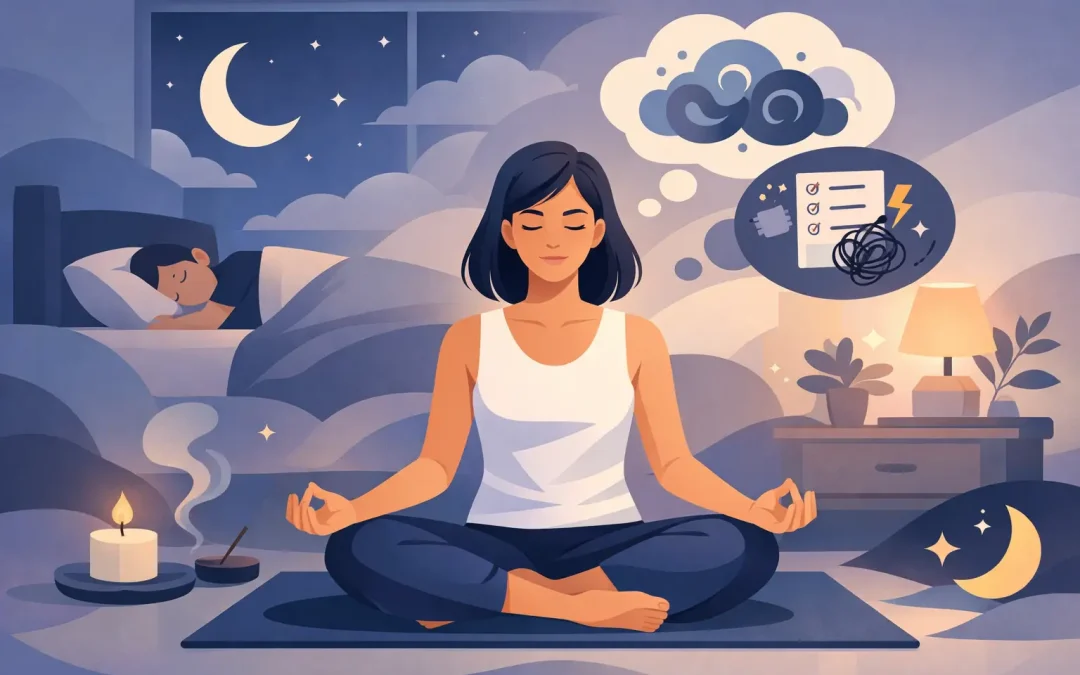
Your body is tired, yet your mind is still holding meetings at 2 a.m. You replay the conversation, revisit the decision, wonder whether you have done enough, and make a silent promise to be more productive tomorrow. Yoga for better sleep is not about forcing yourself into stillness or becoming better at bedtime. It is an invitation to let your nervous system receive the message that the day is over and that, for this moment, you are safe to soften.
For high-achieving women, sleep struggles are rarely only about sleep. They can be the body’s response to carrying too much for too long: responsibility, ambition, family needs, a business, an old fear of disappointing people, or the belief that rest must be earned. You may know all the right wellness advice and still find yourself exhausted but unable to let go.
A gentle evening yoga practice can become a bridge between the woman who has been holding everything together and the woman underneath who deserves to be held, too.
Why yoga for better sleep works differently
Sleep is not something we can command. The more we chase it, check the clock, and criticize ourselves for being awake, the more alert the system can become. Your body does not respond to pressure with surrender. It responds to cues.
Slow, supported yoga offers those cues through breath, stillness, gravity, and compassionate attention. It can lower the physical charge that lingers after a demanding day: tight shoulders, a clenched jaw, shallow breathing, restless legs, and the subtle readiness to react. When you stay in simple shapes without striving to achieve them, you practice a different inner message: nothing needs to be solved right now.
This is why restorative and yin-inspired yoga can be especially supportive in the evening. Faster, heated, or highly stimulating classes may feel wonderful at another time of day, but they can leave some people more energized before bed. There is no universal rule. Notice how your own body responds. If a practice makes you feel clear, warm, and peaceful, it may serve your sleep. If it leaves you wired, emotionally activated, or overly alert, choose something gentler.
Yoga also makes room for what productivity often pushes aside. In the quiet, you may notice grief, anger, loneliness, excitement, or the sadness of how hard you have been on yourself. That is not failure. It is information. Rest becomes deeper when we stop abandoning our inner truth simply because it is inconvenient.
A 15-minute evening practice for deeper rest
You do not need a perfect studio, special flexibility, or an hour of free time. Wear something comfortable, dim the lights, and gather a pillow, folded blanket, or a few cushions. If you practice in bed, keep the shapes very simple and choose positions that help you feel sleepy rather than engaged.
Approach this practice as a ritual of coming home to yourself, not another item to complete beautifully.
Start by arriving in your body
Lie on your back with your knees bent and your feet wider than hip-width apart. Let your knees rest gently toward one another. Place one hand over your heart and the other over your lower belly.
For two minutes, breathe naturally. Do not try to take huge breaths. Instead, allow the exhale to become a little longer and quieter than the inhale. You might silently say, “I am here,” on the inhale and, “I can let go,” on the exhale.
If thoughts continue, that is completely normal. You are not trying to erase your mind. You are giving your attention a kinder place to land.
Release the day from your hips and back
Bring the soles of your feet together and let your knees open outward into a supported butterfly pose. Place pillows beneath your thighs if your hips feel tight or vulnerable. Stay for three to five minutes.
The hips are often described as a place where we hold emotion, but you do not need to force a big release or create a dramatic experience. Simply feel the support beneath you. Let your belly be soft. Let your face soften. If a feeling arises, meet it with the same tenderness you would offer a dear friend.
For some women, opening the hips can feel too exposed at night. If that is true for you, return to the knees-bent position or place your lower legs on a chair. Safety is more restorative than intensity.
Let your spine be supported
Move into a gentle reclining twist. Keep your knees bent, then slowly guide them to one side while your arms rest comfortably away from the body. A pillow under your knees can make this pose feel deeply nurturing. Stay for two minutes, then change sides.
As you breathe, imagine you are wringing out the urgency of the day, not from a place of force, but through surrender. The emails can wait. The unanswered questions can wait. You do not have to carry tomorrow while you are lying here tonight.
Choose a forward fold that feels like refuge
Come into child’s pose with a pillow or bolster beneath your chest, allowing your head to turn to one side. If kneeling does not feel comfortable, sit on the floor or your bed and fold gently over a pillow in your lap.
Stay for three to five minutes. Feel the back of your body expand with each breath. Many women spend their day facing outward: responding, presenting, leading, creating, and caring. This shape lets you turn inward. It reminds the body that it does not need to be visible, impressive, or available right now.
Finish with legs elevated and nothing to prove
Lie down and place your lower legs on a chair, sofa, or stack of cushions so your knees are comfortably bent. Rest here for three to five minutes. If it feels good, cover yourself with a blanket.
Before you get up, ask yourself one gentle question: “What can I put down until morning?” You do not need an answer. Let the question settle into you. Then roll onto your side, pause, and move slowly toward bed.
The real shift is consistency, not complexity
One deeply relaxing practice can feel wonderful. Yet the nervous system learns through repetition. A short ritual most nights often has more impact than an elaborate practice you only do when you are already at breaking point.
You might pair your yoga with one small boundary: putting your phone away 20 minutes before bed, lowering the lights after dinner, or writing down tomorrow’s three most important tasks so your mind does not have to keep rehearsing them. This is not about becoming rigid. It is about creating conditions in which rest has a chance to find you.
If you wake in the night, resist turning the moment into a performance review. Rather than asking, “Why am I still awake?” try placing a hand on your heart and lengthening your exhale for a few rounds. If you are awake for a long time, a brief supported pose or quiet breathing outside the bedroom may be more helpful than fighting under the covers.
When sleep needs more than yoga
Yoga can be a profound support, but it is not a replacement for medical care. Ongoing insomnia, loud snoring, gasping during sleep, severe anxiety, depression, trauma symptoms, or exhaustion that affects daily life deserve attention from a qualified health professional. If you are pregnant, recovering from an injury, or managing chronic pain, adapt poses with appropriate guidance.
It is also worth being honest about the deeper patterns that may be keeping your system on guard. Sometimes sleeplessness is connected to a life that asks you to override yourself all day. It may be a sign that your boundaries, grief, fear of visibility, relationship stress, or old survival strategies need loving attention. This is where deeper inner work can complement the physical practice. Your body is not betraying you. It may be asking to be listened to in a new way.
At Petra Rakebrandt’s yoga and healing work, the invitation is never to fix yourself into worthiness. It is to meet the parts of you that have been working so hard to keep you safe, and to give them another possibility.
Tonight, let your practice be small enough to keep. Let it be quiet enough to hear yourself. The most powerful thing you may do before sleep is not solve one more problem, but offer your body the experience of being allowed to rest.